
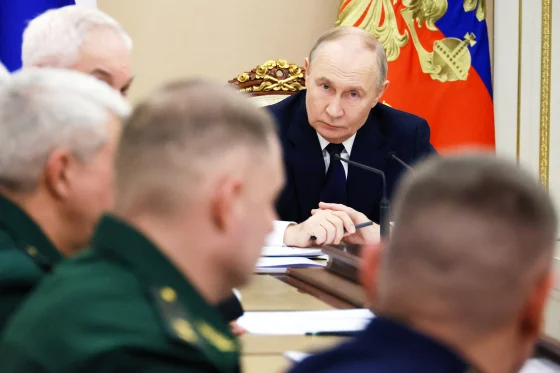
The Kremlin’s claim that Ukrainian forces launched a drone attack on one of President Vladimir Putin’s residences has quickly emerged as a focal point in the information dynamics surrounding the nearly four-year war in Ukraine. Moscow alleges that Ukraine deployed around 90 long-range unmanned aerial vehicles (UAVs) against a state residence in the Novgorod region, roughly northwest of Moscow, in an overnight operation. Russian officials insist that all drones were intercepted by air defenses, with no reported casualties or visible damage, and have described the incident as an act of “state terrorism.”
However, the claim has been met with sharp skepticism internationally and robust denial from Kyiv, complicating its credibility and fueling debate over its timing and purpose. Ukrainian President Volodymyr Zelenskyy dismissed the accusation as a “complete fabrication” and “typical Russian lies,” asserting that Russia is using the narrative as a pretext for further military strikes and to undermine progress in ongoing peace negotiations with the United States.
Conflicting Narratives: Claim and Counterclaim
The Kremlin, through Foreign Minister Sergey Lavrov and presidential spokesperson Dmitry Peskov, has publicly framed the alleged drone operation as a direct assault on Russia’s leadership and sovereignty. They maintain that Ukraine aimed not just at a residence but at Russia’s political signal, painting Kyiv as willing to escalate the conflict dramatically. Peskov said questions about physical evidence are moot because Russian defenses “shot down” the drones before they could reach their target.
Yet, independent analysts and foreign officials note the absence of verifiable evidence—no open-source imagery, no local reports of wreckage or explosions, and no corroborating testimony from regional authorities. The Institute for the Study of War, a respected U.S. research organization, has highlighted the lack of indicators normally associated with a significant drone strike inside Russian territory, which typically leave a trail of footage, eyewitness accounts, or physical proof. This lack of evidence further undermines claims that such an attack occurred.
Timing and Strategic Context
The timing of the allegation has drawn particular scrutiny. It came immediately after high-level discussions between Zelenskyy and U.S. President Donald Trump at Mar-a-Lago, where leaders expressed cautious optimism about progress toward a structured peace agreement and possible security guarantees for Ukraine. Many analysts and officials from Kyiv argue that Moscow’s claims were intended to derail that momentum, injecting a crisis narrative that could justify hardened negotiating positions or renewed military actions.
President Trump, after speaking with Putin by phone, said he was “very angry” about the allegation—but also suggested uncertainty about its veracity, acknowledging that evidence was not publicly available. Trump’s reaction underscored the delicate position Western leaders face, balancing support for Ukraine with the complexities of managing broader diplomatic channels with Russia.
International Reactions and Diplomatic Fallout
The response from the global community has been mixed. Several countries, including the United Arab Emirates, issued statements condemning what they described as an “attack on Putin’s residence,” underscoring their stance against acts seen as threatening international security. However, many Western governments and analysts have been more cautious, emphasizing the need for independent verification while acknowledging the propaganda dimensions of the Russia-Ukraine conflict.
Zelenskyy and other Ukrainian officials have pressed allies to critically assess the Kremlin’s narrative, warning that unverified claims could be exploited to justify further Russian assaults on Ukrainian infrastructure or to stall peace efforts. They argue that accepting the allegation at face value plays into Moscow’s strategic communications campaign and distracts from the core issues in negotiations, including territorial disputes and security arrangements.
Information Wars and Narrative Shifts
Whether or not the alleged drone attack actually occurred, its political utility for the Kremlin is evident. By framing the situation as an attempted strike on Russia’s leader, Moscow positions itself as a victim of aggression even as it pursues expansive military objectives in Ukraine and resists concessions in diplomatic talks. This narrative pivot enables Russian authorities to reinforce internal cohesion, justify defensive and retaliatory measures, and recalibrate international perception in a conflict fatigued by repeated controversies and ceasefire setbacks.
At the same time, the counter-narrative from Kyiv and Western analysts emphasizes disinformation risks, pointing out that exaggerated or false claims can rapidly escalate tensions and cloud efforts to build consensus toward a negotiated solution. The broader implication is that in modern conflicts, information and narrative control are as strategically significant as battlefield advances.
Conclusion
The alleged drone strike on President Putin’s residence illustrates how swiftly events—real or claimed—can influence diplomatic trajectories and shape international discourse. In the absence of credible evidence, the episode currently serves less as a confirmed military milestone and more as a case study in strategic narrative management, underscoring the complexities of interpreting and responding to information in times of war. As peace talks stall and military operations continue, distinguishing fact from politically useful fiction will remain a central challenge for policymakers, journalists, and the public alike